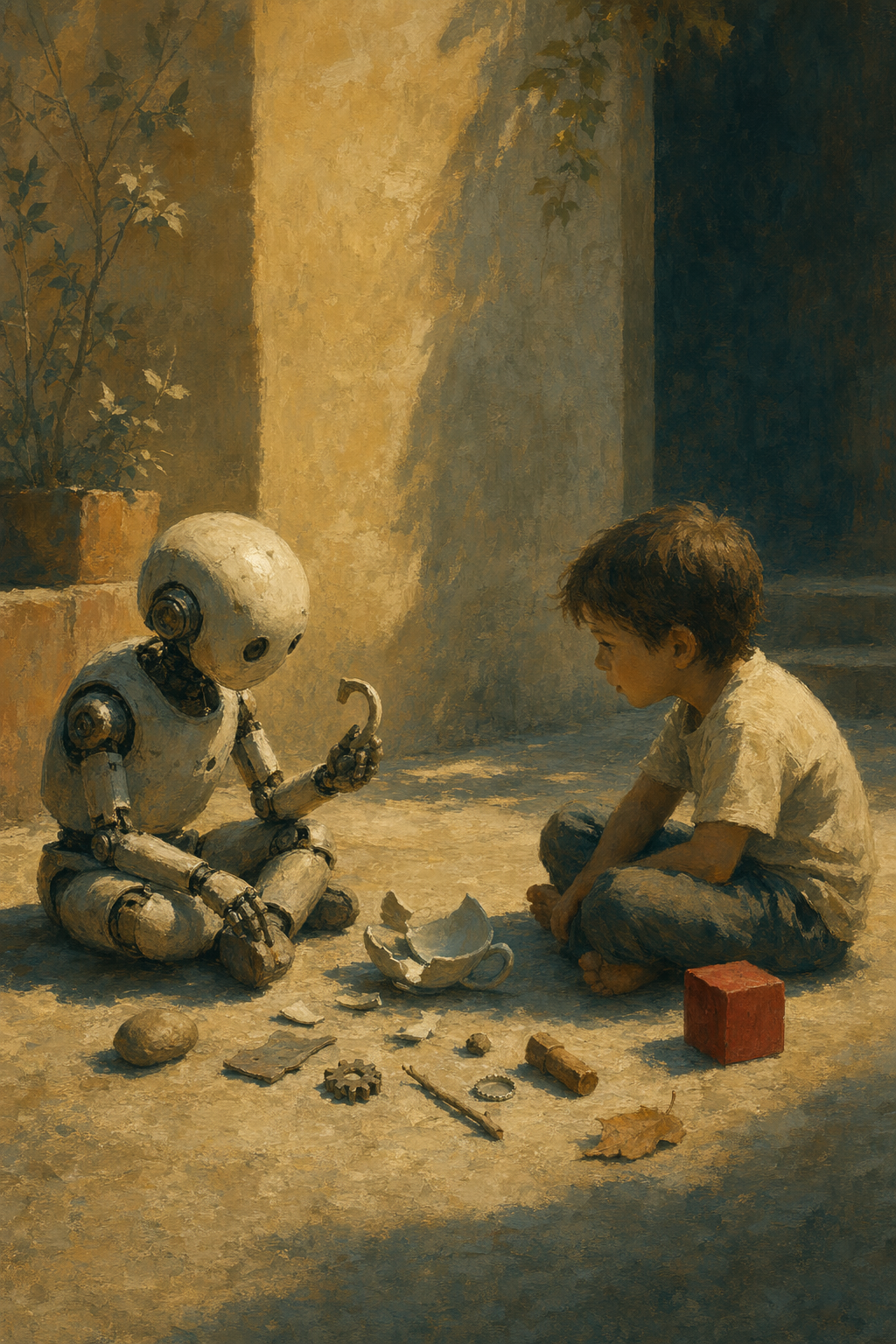
The constructed self and practice-based cognitive technology
The “I” is a running inference. What happens when we can read the source?
There’s a very old question underneath all of this: is there really an ‘I’ in there, or is it a stream of inference wearing a name. Modern neuroscience, psychedelic research, contemplative tradition, and a handful of weird clinical cases all keep arriving at the same answer from different directions — the self you feel is something the brain is continuously assembling, not something it is. A process. A running model. Most people go their entire lives without ever quite looking at the thing doing the looking.
The strange and beautiful parallel fact is that humans spent thousands of years developing technologies for working with exactly this. Contemplative traditions, somatic practices, ritual, breathwork — reliable interventions on states of mind, refined empirically over generations, that modern science has mostly shrugged at because they came wrapped in religion. But they’re engineering. They just never got to call themselves that.
What’s new is that we can finally start to measure what these practices actually do. Imaging that can watch the self assemble in real time. Language models that can formalize phenomenology in ways practitioners couldn’t. Psychedelic research legal enough to be serious. If we pull this together in the next decade, we get precision tools for a part of the human condition currently handled with blunt pharmacology and talk therapy — mental illness reframed as failures of self-construction, existential suffering reframed as an engineering problem. Not to dissolve the self. To understand it well enough to repair it when it breaks.